
Desiccants don’t have a simple expiration date; instead, they continue adsorbing moisture until they reach their individual equilibrium capacity—the point at which they can no longer remove additional water vapor given the surrounding temperature and relative humidity (RH). Therefore, desiccant life is not a function of time alone. Rather, desiccant life span depends on how the material is stored, how much moisture it must manage, and how frequently the protected space is exposed to humid air.
The Difference Between Shelf Life and Operational Life
“Shelf life” and “service life” describe two different conditions.
Desiccant Shelf Life
Shelf life refers to how long desiccant remains usable while stored in the original protective packaging.
AGM provides a 1-year shelf life warranty, assuming:
- The recommended storage conditions are maintained.
- The packaging remains unopened and undamaged.
- The desiccant is protected from ambient moisture.
AGM recommends storing packaged desiccant between 0 F and 90 F (-17 C and 32 C) and 0% to 75% relative humidity. Standard packaging may include low-moisture-vapor-transmission poly bags, metal cans, plastic pails or partially evacuated barrier bags. Additionally, some products may include sacrificial desiccant in order to account for expected moisture exposure before installation.
Desiccant Operational Life
Operational life refers to how long the desiccant remains useful once its package is opened and the desiccant is placed into service.
As soon as a desiccant is exposed to the surrounding environment, it immediately begins adsorbing moisture from the air. As a result, a desiccant’s useful life depends on a great many variables and not only time. Such variables include:
- Initial moisture trapped during assembly.
- Enclosure volume.
- External temperature and humidity.
- Enclosure leakage.
- Moisture permeation through seals and materials.
- Frequency of exposure to ambient air.
- Pressure changes and breathing cycles.
- Desiccant type and quantity.
- The humidity or dew-point target inside the enclosure.
Notice that operational life requires analysis of temperature, humidity, pressure differentials and, when applicable, changing elevations.
Why do Desiccants Stop Functioning?
Desiccants will stop adsorbing moisture once they reach their equilibrium capacity.
Desiccants adsorb water molecules onto open pores in the material. As more moisture is collected, those pores gradually fill. It’s important to note here that this is a chemical bonding process and is different from absorption.
A desiccant reaches it equilibrium capacity, or is considered saturated, when it can no longer adsorb additional water vapor at the surrounding RH level.
Moreover, if temperature rises, the forces holding water molecules to the desiccant weaken, and a desiccant can release moisture back into the surrounding environment rather than continuing to protect it. This phenomena may occur whether a desiccant is saturated or not, as it’s a matter of temperature.
How Much Moisture Until Desiccant Reaches Equilibrium Capacity?
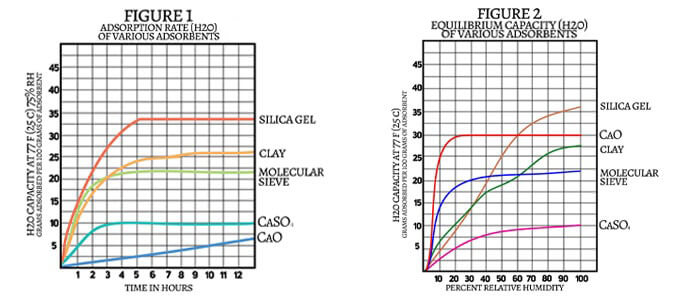
Equilibrium capacity is not a fixed number but changes with the environment around a desiccant; namely RH and temperature.
Further, each desiccant material has a different adsorption rate and equilibrium capacity, which is why it’s important to select the right desiccant for a given project. For example:
- Silica gel performs generally well in through a wide range of RH and temperature.
- Molecular sieve generally performs better in higher-temperature, lower-humidity environments and applications.
- Clay is most appropriate for less demanding humidity-control applications under normal temperature ranges.
What Shortens Desiccant Operational Life?
Exposure to Air Before Installation
Once protective packaging is opened or damaged, desiccant begins adsorbing moisture from ambient air. As such, it is best to limit exposure as much as possible.
High Humidity
The more moisture in the air surrounding a desiccant, the faster its available capacity is taken up. Therefore, it’s important to control moisture and air ingress among enclosures wherein you’re installing desiccant.
Temperature Changes
Temperature affects adsorption capacity and can contribute to desorption. It also changes enclosure pressure, contributing to overpressure events, which may cause the enclosure to inhale humid ambient air during cooling cycles.
Enclosure Leakage and Permeation
Moisture may enter through imperfect seals, cable interfaces, polymers and other nonhermetic materials. Even small, continuous moisture loads can eventually saturate a desiccant.
Pressure Equalization
Breather valves protect enclosures from damaging pressure differentials, but inward airflow may introduce additional moisture. In breathing applications, the desiccant must manage both the initial moisture load and moisture carried into the enclosure during operation. AGM notes that this makes substantial extensions of operational life difficult in some applications.
Can Desiccant Life Be Extended?
Desiccant life may be improved, but the best method depends on whether the material is in storage or is already installed.
Before installation
- Keep packaging sealed until the desiccant is ready for immediate use.
- Store it within the recommended temperature and humidity range.
- Protect packaging from punctures and seal damage.
- Use higher-performance barrier packaging when a longer shelf life is required.
- Limit the amount of time the desiccant is exposed during assembly.
During operation
- Improve enclosure sealing where practical.
- Reduce uncontrolled air exchange.
- Select a desiccant suited to the expected temperature and humidity.
- Provide enough capacity for the initial moisture load and anticipated ingress.
- Use indicating desiccant, humidity indicator cards or sensors to monitor conditions.
- Establish a replacement interval based on the operating environment.
- Consider a breathing desiccator when pressure equalization and incoming-air drying are both required.
Material selection, packaging, enclosure design and exposure frequency all influence usable life; meaning that adding more desiccant is not always the right strategy.
How Much Desiccant Do I Need?
A common starting point is 1.2 units of desiccant per cubic foot of protected air volume.
Under MIL-D-3464E, one unit is defined as the amount of desiccant capable of adsorbing at least:
- 3 grams of water vapor at 20% relative humidity, and
- 6 grams of water vapor at 40% relative humidity,
at 77 F (25 C). Because different desiccant materials meet this requirement at different weights, one “unit” does not represent the same mass for every material.
This rule of thumb is useful for preliminary estimates, but it does not by itself predict service life. A life estimate must also account for the rate at which moisture enters the system.
For a quick estimate, use AGM’s free desiccant unit calculator. For more complex projects or when requiring precise moisture control, consider AGM’s Moisture Analysis Service.
Questions to Ask to Better Estimate Service Life
Before establishing a replacement interval, answer the following for yourself:
- What is the enclosure’s internal free volume?
- What humidity or dew point must be maintained?
- At what temperature and relative humidity will the enclosure be assembled?
- What temperature range will it experience during storage or operation?
- What materials make up the housing, seals and packaging?
- What is the anticipated leakage or permeation rate?
- Will the enclosure experience pressure or altitude cycling?
- How frequently will it be opened for inspection or maintenance?
- How much space is available for desiccant?
- Can the desiccant be inspected or replaced?
- Is a humidity indicator or sensor required?
- What service interval must the design support?
How to Know When to Replace Desiccants
Replacement decisions may be based on one or more methods:
Color indication
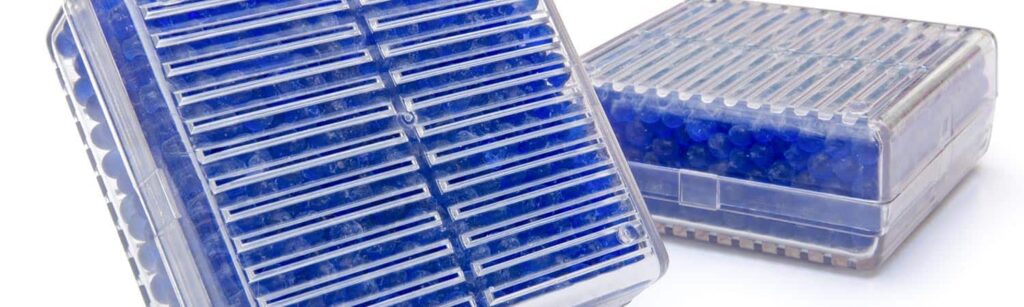
Blue or orange indicating silica gel changes color as saturation increases. This provides an immediate visual condition check.
Humidity indication
A humidity indicator card or sensor can show whether the protected space has exceeded its acceptable humidity threshold.
Scheduled replacement
For predictable applications, engineers may establish a maintenance interval based on estimated moisture ingress and desiccant capacity.
Desiccant Service Life Is Dependent Upon the Installation Process and Service Environment
In summary, there is no universal answer to “How long will my desiccant last?” Rather, a desiccant’s operational life is the result of two competing quantities:
Available adsorption capacity compared with the rate at which moisture enters the protected environment.
While increasing the amount of desiccant increases total available capacity, improving packaging, seals and airflow control reduces the moisture load and may ultimately be more beneficial. Further, selecting the appropriate desiccant type serves to ensure that the capacity remains useful under the expected temperature and humidity conditions.